Pool Deck Paver Sealing in Treasure Island & Pinellas County
Pool decks deal with chlorine, sunscreen, salt water and bare feet all summer. Paver Ink seals pool deck pavers with a finish chosen for the surface rather than a default, so the color comes back without the deck turning slick underfoot.
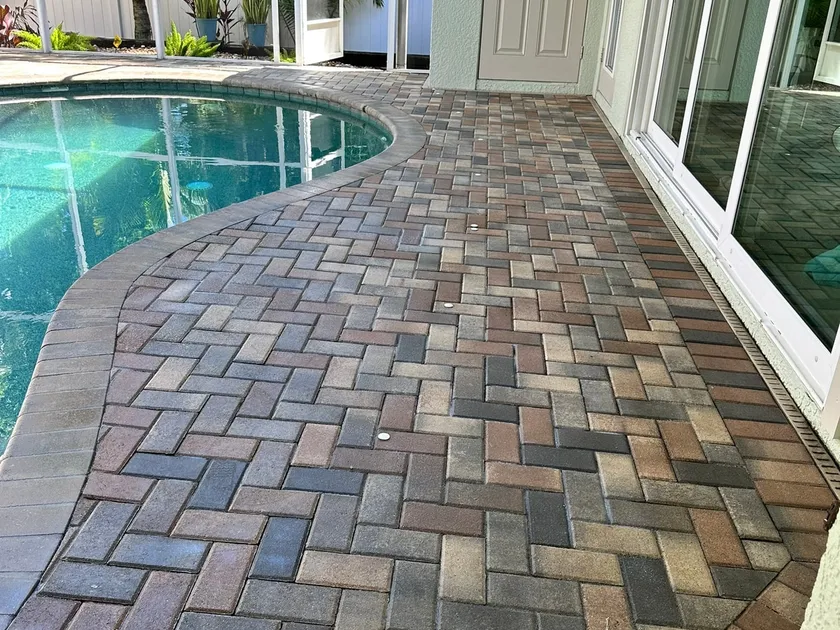
About pool deck sealing
A pool deck is a chemistry problem
Chlorine or salt splashes out every time somebody gets in. Sunscreen and body oil transfer off skin onto stone. Add Florida sun and constant wet traffic and you have a surface degrading in several ways at once.
Sunscreen is the one people are surprised by. Modern mineral formulations leave an oily residue that soaks into an unsealed paver and shows up as dark blotches near the steps and loungers.
Finish choice is a safety decision here
Around a pool this is not about looks. A high-gloss wet-look sealer leaves a smooth film, and a smooth film under bare wet feet is genuinely dangerous.
We use matte or low-sheen finishes on pool surrounds, and a grip additive can go into the top coat where you want more certainty. If a contractor quotes a wet-look finish for a pool deck without raising this, ask why.
Travertine needs different handling
A large share of Florida pool decks are travertine rather than concrete paver. It is softer, more porous, and will not tolerate the cleaning pressure a concrete paver shrugs off. It needs a natural-stone sealer and a gentler approach throughout.
The white haze around the coping
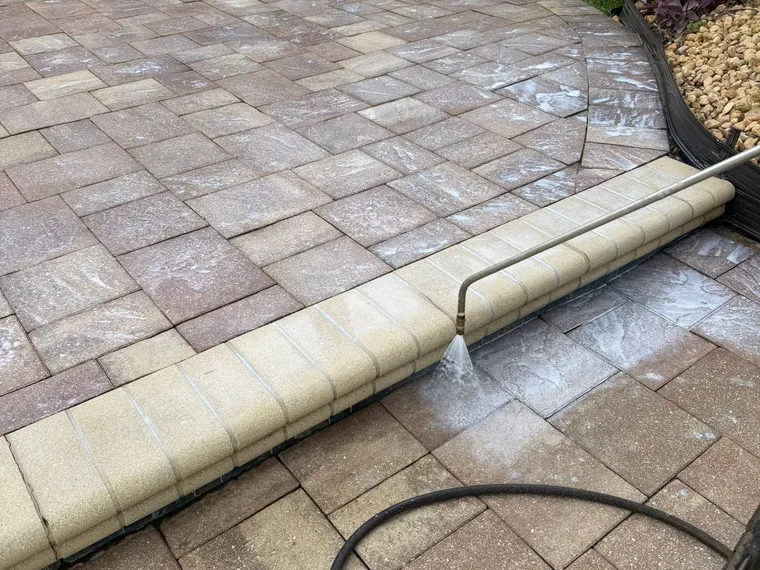
That is efflorescence, mineral salts migrating up through the paver and drying on the surface. Ordinary cleaning barely touches it. It needs a dedicated efflorescence treatment first, and sealing afterwards slows how quickly it comes back.
Four steps, no surprises
-
Walk the job
We measure the field, count the joints and tell you what the surface actually needs. If sealing is the wrong call, we say so.
-
Clean & sand
Surface clean, then hand detail the edges and stains. Polymeric sand gets swept and set into every joint.
-
Seal
Two coats, wet-look or matte, applied once the pavers read dry all the way through. Damp pavers are how sealer goes cloudy.
-
Walk it again
You look at it with us before we load the trailer. Anything off gets fixed that day, not on a callback.
Recent work
Pool deck sealing questions
Will sealing make the deck slippery?
Not if the right finish goes down. High-gloss wet-look sealer on a pool surround is a genuinely bad idea. We use matte or low-sheen finishes around pools, and there are grip additives that can go into the top coat if you want more.
Does sealer hold up to chlorine and salt systems?
Yes. Pool-appropriate sealers are made for constant water contact and pool chemistry. That is exactly why the product choice on a pool deck should not be the same as the one on a driveway.
How long does the pool need to be out of use?
The pool itself stays usable. It is the deck that needs to stay clear. Typically that means keeping furniture and foot traffic off for the rest of the day, with the deck back to normal the following morning.
Can you fix the white haze around my pool coping?
That is usually efflorescence, mineral salts migrating up through the paver and drying on the surface. It needs an efflorescence treatment rather than ordinary cleaning, and sealing afterwards slows how fast it returns.