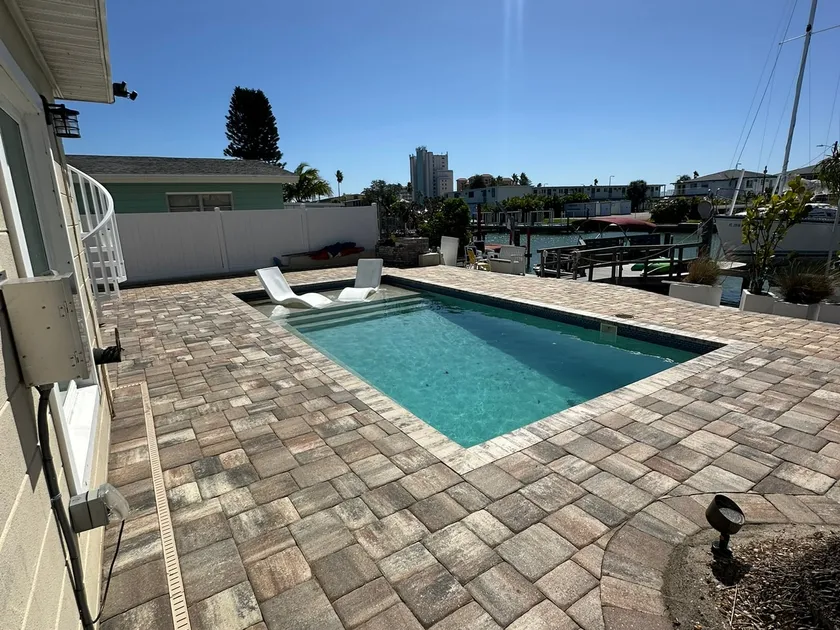
Already know what you need? Go straight to pool deck paver sealing.
What a pool deck is actually up against
Splash-out carries chlorine or salt onto the pavers every time someone gets in. Sunscreen and tanning oil soak into unsealed stone and leave dark blotches around the steps and loungers. Bare wet feet track water and grit across the same paths all day.
None of that happens to a driveway. It is why a pool deck should not be sealed with the same product as one.
The slipperiness question, answered properly
A sealed pool deck is not inherently slippery. A glossy one is. High-gloss wet-look sealers leave a smooth film, and a smooth film under wet feet is exactly the problem you are imagining.
The answer is a matte or low-sheen finish around water, and a grip additive mixed into the top coat where you want more certainty. Both are standard, and both are worth asking any contractor about before they start.
What sealing fixes on a pool deck
- Sunscreen and body oil stop soaking into the paver
- Chlorine and salt stop leaching color out of the surface
- Efflorescence, the white mineral haze near coping, comes back more slowly
- Joint sand stays put instead of washing into the pool
- Algae in the shaded corners has far less to grip
Travertine and natural stone are different again
A lot of Florida pool decks are travertine rather than concrete paver. Travertine is softer, more porous and much less tolerant of aggressive cleaning. It needs a sealer formulated for natural stone, and cleaning pressure well below what a concrete paver would take.
Still not sure? Send us the surface, the city and a rough size. We will tell you whether cleaning, sealing, re-sanding or restoration is the right next step, including when the answer is that you do not need us yet.
Get a free estimate